Looking to file a new VA disability claim? Or to increase your rating so you can receive 100% disabled veteran benefits?
Once you file your claim, the VA may reach out to you about getting a C&P exam (Compensation and Pension exam). This is a medical evaluation conducted by a Department of Veterans Affairs (VA) provider (or contracted provider).
This exam is not about treating your health problems. Rather, its purpose is:
- To determine if your health condition is connected to your military service
- To assess how severe your service-connected condition is
The exam notes will be added to your claim, and the reviewer will use these notes to make a decision about your disability rating.

(freepik/Freepik)
Why the C&P Exam Is So Important
The C&P exam is often the most critical piece of evidence in your VA disability case. Here’s why it matters so much:
1. It Significantly Impacts Your Disability Rating
VA raters lean heavily on C&P exam results because they come from a medical professional authorized by the VA. What you say, how you act, and what the examiner observes during this appointment can influence whether your claim is approved, denied, or assigned a higher or lower rating.
2. It Validates Worsening Conditions
If you’re seeking an increased rating, this exam provides updated evidence of how your condition has changed since your last evaluation. If you don’t show up for your exam—or don’t accurately describe how the condition affects your life—your request could be denied or deferred.
3. It Can Influence Back Pay
The VA will consider the date your condition appeared or worsened as part of the calculus for determining backpay. A detailed and accurate C&P exam may support higher retroactive payment if the evidence lines up.
Get Prepared with These Steps
Your goal is to show up for your exam with the right documentation and honest, consistent details about how your condition impacts your life. Here are seven expert strategies to help you excel in your C&P exam and get the VA disability rating that you deserve:
1. Review and Bring Your Medical Records
Before your exam, meticulously examine your military service treatment records, VA medical files, and any private healthcare documentation. Understand the details of your diagnoses, symptom history, and how your current condition connects to your military service. Being well-versed in your medical history allows you to provide accurate and comprehensive information during the exam.
Don’t assume that the VA provider will have a copy of your military medical records. Often they do, but some providers are contracted and may not be able to pull up your records as easily. For best results, bring a copy of your medical records with you.
2. Familiarize Yourself with VA Rating Criteria
Study the VA’s Schedule for Rating Disabilities (38 CFR Part 4) to understand how your condition is evaluated. This knowledge helps you articulate your symptoms in a way that aligns with the VA’s rating standards.
For example, if you are hoping for a 50% rating for insomnia, you can see that the criteria references an “occasional decrease in work efficiency” as well as symptoms like depressed mood, anxiety, suspiciousness, panic attacks (weekly or less often), and mild memory loss. If you are familiar with this criteria, you will be prepared to describe how your own symptoms fit the requirements.
3. Prepare to Describe Your Worst Days
You may be tempted to put on your “game face” like you did in the military. But this is not the time to pretend like you are sailing through life. If your health problems have worsened your self-care, don’t go into your appointment with 10/10 grooming.
During the exam, focus on conveying the severity of your symptoms on your most challenging days, rather than on days when you feel better. The VA assesses your disability based on its impact during your worst periods, so provide an accurate depiction of those times.
4. Practice Telling About “A Day in the Life”
Be candid about your experiences, even if discussing them is uncomfortable. Share the full extent of how your condition affects your ability to work, maintain relationships, and perform everyday activities. Use specifics to describe physical and mental effects. Do your physical ailments keep you from focusing on the task at hand? Are you unable to participate in usual family activities because of your physical pain? Do you find it hard to get out of bed in the morning for physical or emotional reasons? Is your condition affecting your marriage? Have you lost interest in things you used to enjoy? Have you been fired from a job due to your condition?
Practice describing these things in front of a mirror or, better yet, with a trusted friend. That way, you can make sure you’re describing things as effectively as possible when you get to your exam.
5. Recount Relevant Service Events
Be prepared to discuss incidents or exposures during your military service that contributed to your current health issues. When you share the details of these events, it helps you establish a direct connection between your service and your disability, which is vital for your claim.
6. Bring Supporting Documentation
In addition to your medical records, consider bringing:
A Nexus Letter
This is a letter written by your physician (often a private physician) explaining that it is “at least as likely as not” that your medical condition is connected to your military service.
A Personal Statement
Consider writing a personal statement to add to your VA claim. This is a brief statement describing how your condition started, how it is related to your military service, and how it affects you from day to day. It should not include non-military-related events.
For example, if you are claiming depression and you use your personal statement to explain that your parents divorced when you were young, you could give the VA a reason to pin your depression on childhood events. Your personal statement should only include details pertinent to your military service and how your service-related health condition affects your life.
Pro-tip: Ask your doctor if you can read your personal statement aloud. This will make sure that you communicate all relevant details without going “off-script” and saying something that won’t support your claim.
Medical Evidence
Not every doctor is an expert in every aspect of health or the latest research on every condition. So if you have strong evidence (like double-blind, placebo-controlled studies) that support your claim, you can respectfully present them to your provider. For example, let’s say that you have a VA rating for PTSD and want to file for GERD (gastroesophageal reflux disease) secondary to PTSD. You could bring your doctor a copy of a medical study showing that people with high levels of stress often produce more stomach acid, which can lead to GERD.
7. Plan to Arrive Early
Before your appointment, take the time to map out your route to the medical facility. Plan to arrive at least 30 minutes early. You never know what traffic delays could pop up or if there will be parking challenges at the facility. Given the importance of this exam, it’s best to err on the side of caution.
After the Exam
After the exam, request a copy of the examiner’s report. Review this document to make sure your doctor recorded things accurately. Call immediately if you notice any inaccuracies.
Preparation is Key
You will likely just get one shot at a C&P exam. Put in the time and effort to make sure you make the most of it. And if you need help preparing, contact an experienced VA claim consultant. They can help you gather the proper documentation (including procuring a nexus letter), create a winning personal statement to take to your exam, and communicate professionally so you can get the rating and compensation you deserve.
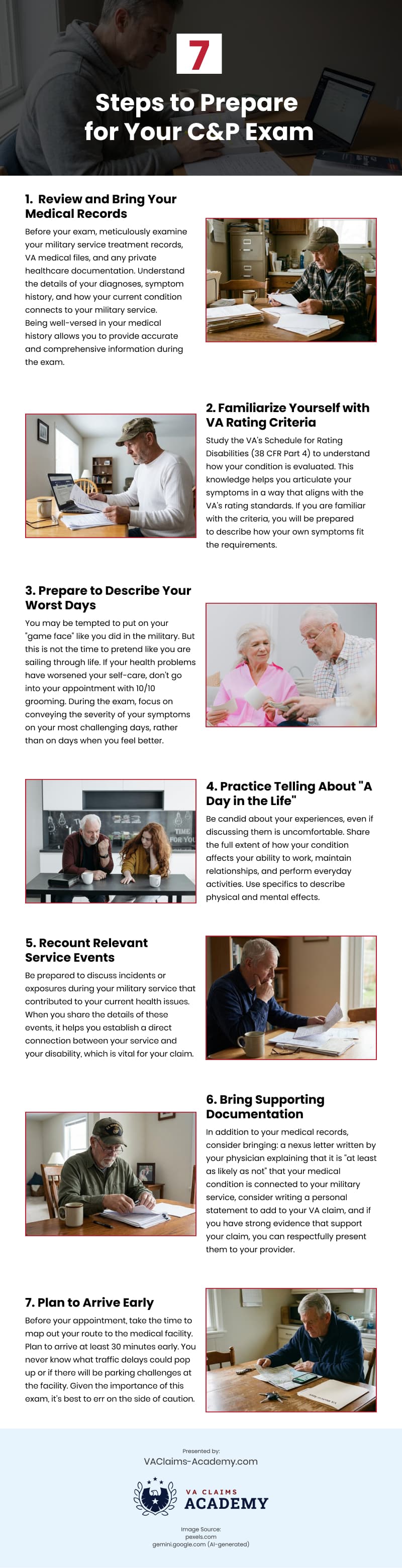
Infographic
After you submit a VA disability claim, the C&P exam becomes a crucial part of the process. This exam has a direct impact on how the VA assesses your condition. To help you prepare for your C&P exam, check out this informative infographic on the steps to take.