38 CFR, Part 4, Subpart B
If you’re a veteran living with chronic back pain, you’re not alone, and you’ve probably wondered how the VA decides what your condition is worth. Back pain is one of the most common issues among veterans, and it’s also one of the most frequently claimed disabilities with the VA. But many veterans are rated at a mere 10%, even though their back pain dominates so many parts of their life.
Unfortunately, getting the rating you deserve isn’t always straightforward. You have to understand how the VA classifies back conditions, how they evaluate severity, and what you can do to present a strong case.
You might already know that the VA uses a percentage-based system to rate disabilities. When it comes to back pain, your rating is based on how much your condition limits your ability to move, function, and work. The problem is, back pain is a broad category—and your exact rating will depend on the specific diagnosis, documented symptoms, and how your condition is evaluated during the Compensation and Pension (C&P) exam.

image
Why VA Ratings for Back Conditions Can Be Tricky
What makes back pain claims so complicated is the subjective nature of the pain itself. Unlike a broken bone or visible injury, back pain can be hard to measure unless it’s backed by clear medical imaging, clinical documentation, and functional limitations. You might feel pain every day, but if your exam doesn’t reflect that—or if you can still move in ways that seem “normal” to a VA examiner—you could receive a lower rating than expected.
It also doesn’t help that the VA rates most back conditions under a single section of its diagnostic code, specifically 38 CFR § 4.71a, which covers the spine. This section includes conditions like degenerative disc disease, spinal stenosis, herniated discs, and spondylolisthesis. These are all grouped under similar criteria, so if your condition overlaps or presents with multiple symptoms, it may still be rated under one diagnostic code. That means your total rating could be lower than the sum of your pain and limitations unless you know how to navigate the system.
Frequently Rated VA Back Conditions
Degenerative Disc Disease (DDD)
If you’ve been told you have “wear and tear” on your spine, this is likely what your doctor is referring to. DDD is rated based on how much it limits your range of motion, not how much pain you’re in. If you can’t bend or twist very far—or if your movement is limited due to muscle spasms or guarding—you could receive a higher rating.
Herniated Disc
Also known as a slipped disc, this condition occurs when the soft center of a spinal disc protrudes through a crack in the hard outer layer of your spine. This can apply pressure to nerves or to the spinal cord itself. If your discs are bulging or compressing nearby nerves, you might experience radiculopathy, which includes numbness, tingling, or weakness in your legs. In some cases, this secondary condition may qualify you for an additional rating on top of your primary back condition.
Spinal Stenosis
This is a frequently rated condition, especially among older veterans. It refers to the narrowing of the spinal canal, which can compress nerves and cause radiating pain. It’s often mistaken for sciatica but is more progressive and can affect your balance and mobility. If you find yourself unable to stand or walk for long periods, the VA may evaluate you under more severe rating criteria.
Spondylolisthesis
With this condition, one vertebra slips over another. It’s typically caused by trauma or overuse, making it common among veterans with physically demanding Military Occupational Specialty (MOS) roles (heavy equipment, air assault, etc.). This condition can lead to instability, chronic pain, and even nerve damage—symptoms that are often underreported if you don’t have detailed imaging and a strong medical narrative.
How the VA Rates These Conditions
The VA doesn’t just consider the diagnosis—you’ll be rated based on how much your spine can move. During your C&P exam, the examiner will measure your range of motion in degrees, usually using a goniometer. A goniometer is a measuring tool that measures angles, specifically, the angle at which a joint can bend.
The lower your range of motion, the higher your potential disability rating. For example, if you can bend your spine only 30 degrees forward, you might receive a 20% rating. If a portion of your spine is completely immobile due to fusion surgery or ankylosis (where a joint becomes immobile due to fusion of the bones in the joint), you could be rated at 50%. If your entire spine is frozen, your rating could increase to 100%.
How to Support Your Claim
Too many veterans are underrated for back pain, not because they’re not eligible for a higher rating, but because they haven’t submitted a strong enough claim with the appropriate supporting evidence. If you aren’t yet rated, here’s how to get VA disability for back pain, and if you’re underrated, here’s how to increase your rating.
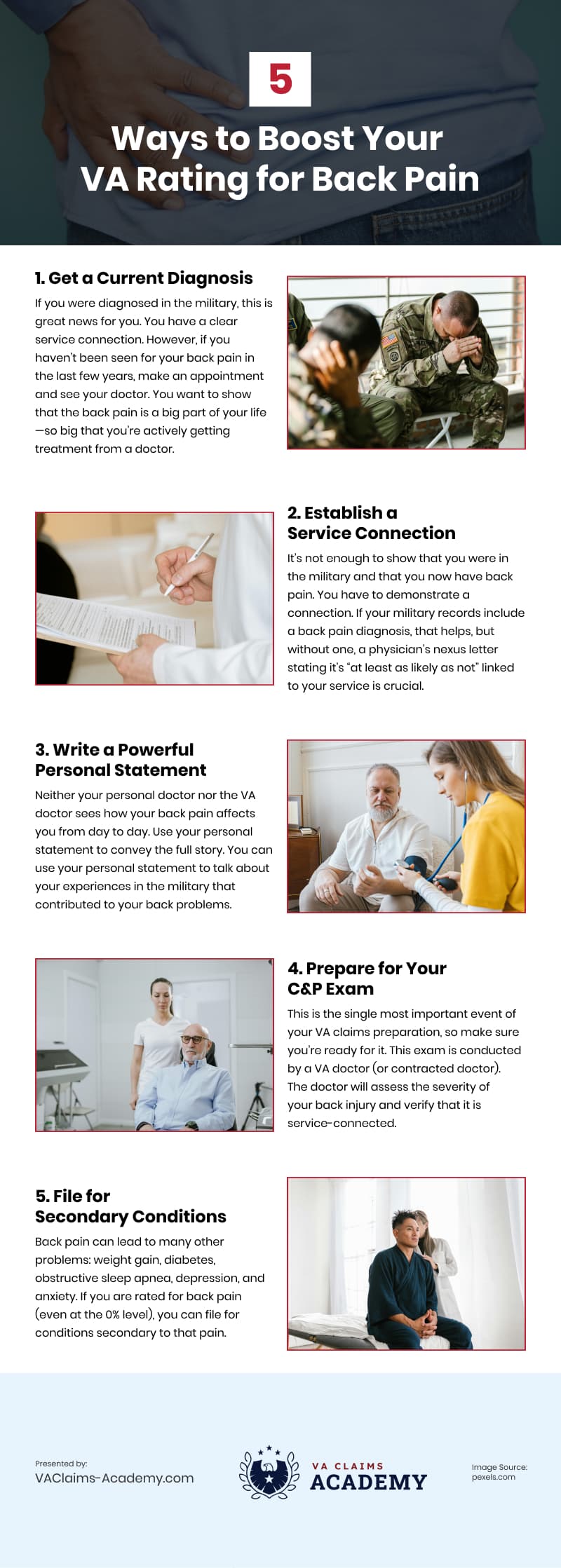
Get a Current Diagnosis
If you were diagnosed in the military, this is great news for you. You have a clear service connection. However, if you haven’t been seen for your back pain in the last few years, make an appointment and see your doctor. You want to show that the back pain is a big part of your life—so big that you’re actively getting treatment from a doctor.
If you haven’t yet been diagnosed, see your provider for a diagnosis as soon as possible.
Establish a Service Connection
It’s not enough to show that you were in the military and that you now have back pain. You have to demonstrate a connection. The military needs to see that your pain was triggered by your time in service.
As mentioned above, if you have a diagnosis of back pain in your military records, you’re in luck. But if not, you will want to get a nexus letter from a physician stating that it is “at least as likely as not” that your back pain is connected to your time in service.
If your MOS regularly exposed you to activities that hurt your back, make sure to explain this to your doctor. And if your doctor is hesitant to write your nexus letter, check into resources from VA Claims Academy. These include a ready-made template that your doctor just has to edit and sign, showing them a helpful format and saving them time.
Write a Powerful Personal Statement
Neither your personal doctor nor the VA doctor sees how your back pain affects you from day to day. Use your personal statement to convey the full story. Does your back pain and limited range of motion keep you from working? Cleaning up your yard? Even doing simple tasks like putting on your shoes? Does your back pain make you irritable and sharp-tongued with your spouse and co-workers? Does it make it difficult to sleep?
You can use your personal statement to talk about your experiences in the military that contributed to your back problems. You can also use it to share when the pain started and how it has worsened over the months or years.
Keep the letter short (just several paragraphs should do). Don’t waste your space talking about non-military events that worsened your back. This could hurt your claim in the end. Keep your focus on your service connection and the toll your service-connected back pain has taken on your life.
Prepare for Your C&P Exam
This is the single most important event of your VA claims preparation, so make sure you’re ready for it. This exam is conducted by a VA doctor (or contracted doctor). The doctor will assess the severity of your back injury and verify that it is service-connected.
Here are some tips to help you prepare:
Bring your medical records with you: We have heard of VA-contracted doctors not having access to your full medical record, so make sure that you have a copy of the records with you.
Bring your personal statement: When you’re on the spot, you may not remember all the things you should tell your doctor, but if you have a well-written personal statement at your disposal, you can simply read it. This will ensure that you share the most compelling details without bringing up things that won’t help your case.
Don’t show up like you’re having your best day: This is not the time for plastering on a happy face. You may feel good at the time of your exam, but you want the doctor to know how your back problems affect you on your worst day. Be honest and don’t try to whitewash the hard details.
Stop when the pain starts: Remember when we talked about the goniometer (measuring device) above? Your doctor is going to use that to measure how much you can move your back. They will measure your ability to bend forward, backward, and from side to side.
DO NOT let the doctor force you into moving into the pain zone. Even if they encourage you to keep bending beyond the pain point or physically put a hand on your back, don’t push yourself farther than is comfortable. When the pain starts, you stop. This is not the time to play tough.
Mention other applicable symptoms (including numbness, tingling, and shooting pain):
If you have experienced any of these symptoms, tell your doctor. Things like numbness, tingling, and shooting bursts of pain are a big deal. They can take your back condition out of the mild zone and move it into the moderate or severe zone, with a commensurate rating and compensation. Don’t gloss over these additional symptoms.
File for Secondary Conditions
Back pain can lead to many other problems: weight gain, diabetes, obstructive sleep apnea, depression, and anxiety. If you are rated for back pain (even at the 0% level), you can file for conditions secondary to that pain.
For example, the average rating for mental health conditions is 70%. So if you are rated for depression or anxiety secondary to back pain, you could tack that 70% onto whatever your current rating is, getting you close to the 100% disabled veteran benefits threshold.
Can I Claim Back Pain if I’ve Been Out of the Military a Long Time?
We have helped many veterans who have been out of the military for decades get rated for back pain. Be aware that the VA is going to try to attribute your back pain to the normal aging process, so you’ll want to show that your back condition has worsened “beyond the normal rate of progression.” If you can get your doctor to write this in your treatment notes or nexus letter, you can increase your chances of getting compensation.
Get Expert Help with Your VA Rating Increase for Back Pain
If you’re overwhelmed or unsure where to start, you’re not alone. Many veterans struggle with understanding how to document their condition in a way that aligns with VA standards. That’s where expert guidance, like the training and strategy you’ll find through programs like VA Claims Academy, can make a difference.
You’ll gain the tools, knowledge, and templates to build a strong case from the start. Back pain may be common, but your experience is unique, and your compensation should reflect the impact it has on your life.
Video

Infographic
Many veterans are often overlooked for higher back pain ratings—not because they’re unqualified, but because their claims lack strong supporting evidence. This infographic provides practical tips to help strengthen your VA disability claim for back pain.