The wounds you carry from serving your country are heavy enough, but, too often, the VA claims process only adds to that burden. You confront confusing forms, deadlines, medical jargon, and legal rules. And you know that one wrong step, such as a forgotten form field, a poorly worded explanation, or a missed document, can delay or derail your benefits entirely.
That’s where a veterans benefits advocate makes a real difference. These professionals understand the VA claims process inside and out. They’ve seen what works and what doesn’t when it comes to getting all different types of claims approved. And most importantly, they work for you, not for the VA.
Their job is to help you file smarter, present stronger evidence, and get the benefits you’ve earned. When you work with an experienced advocate, you’re tapping into insider knowledge that supports your unique claim.

What’s the Difference Between a VSO and a Veterans Benefits Advocate?
A Veterans Service Organization (VSO) is a congressionally chartered or recognized nonprofit organization serving veterans. VSOs like the American Legion, Veterans of Foreign Wars (VFW), Disabled American Veterans (DAV), and Vietnam Veterans of America employ accredited representatives who are trained and certified by the Department of Veterans Affairs to help you with your benefits claims at no cost.
The problem with VSOs is that they are often backlogged, so it might be a while before you can get help. And even when you do get help, you are likely to get broad-brush instruction, not specific strategies geared especially to your claim.
A veterans benefits advocate, on the other hand, is a broader term for anyone who helps veterans navigate the benefits system, including both accredited and non-accredited individuals. While some advocates work for VSOs, others operate independently as private attorneys or claims agents. These advocates may charge fees (either a flat fee or percentage of your backpay) but often deliver great value that goes beyond the more generic assistance that VSOs may provide.
While a VSO may be helpful for straightforward initial claims, a benefits advocate could be a better choice for appeals or complex or high-value cases.
Advocates “Speak VA”
Filing a VA disability claim isn’t just about filling out a form and waiting for a check. Each claim requires a detailed understanding of VA rules and rating schedules and how to present your case in alignment with these requirements.
You might know what your condition is and how it affects you, but translating that into language the VA accepts is another story. A benefits advocate helps you do just that. They know the specific evidence and wording that the VA wants to see. They guide you through the claims process, making sure every form is complete, every deadline is met, and every statement supports your case in the VA’s eyes.
Instead of guessing which documents you need, you get clear direction. Instead of wondering what the VA is looking for in a nexus letter or C&P exam, your advocate explains exactly how to prepare. That guidance can mean the difference between a quick approval and months of frustration.
Stronger Evidence Means Stronger Claims
It’s not enough to tell the VA you’re in pain or that your condition started in service. You need medical and lay evidence that backs your story and connects your condition to your time in uniform.
Benefits advocates help you gather the right records, organize them properly, and, when necessary, work with doctors to request strong, focused nexus letters. These letters are the key to showing a connection between your medical condition and your military service.
A good advocate can spot weak points before your claim is submitted. That way, you’re not scrambling to fix things after a denial. Let’s say you’re trying for a VA disability rating for PTSD. Your advocate might recommend updated therapy records, a personal statement, and a new mental health evaluation.
They’ll help you present those documents in a way that clearly matches the rating criteria, removing doubt from the decision process. They may even be able to provide you with resources to keep you from reinventing the wheel. For example, they may give you a template of a personal statement, so you’ll know what details to include in yours. Or they may give you a template for a nexus letter that you can take to your doctor when you ask him or her to write a similar letter for you. This helps your doctor include key phrases that affirm your service connection in alignment with the VA’s requirements.
Avoiding Costly Mistakes
One of the most common reasons veterans get denied is paperwork: missed deadlines, incomplete forms, or incorrect information. Sometimes it’s as simple as leaving a box unchecked or forgetting to list a secondary condition.
An advocate acts like a second set of eyes. They check for mistakes before the VA sees them. That means fewer denials, faster decisions, and less back-and-forth. If you’ve ever waited six months just to find out your claim was missing one document, you know how important this can be.
And when it comes to appeals, this attention to detail becomes even more valuable. Advocates can spot where the VA misunderstood your case and build a stronger appeal from the beginning, using targeted evidence and clear arguments to support your side.
Trusted Guidance Through Appeals
If your claim is denied or underrated, a benefits advocate can help you understand which appeal option may be best. While many people jump to a formal appeal, this can be costly and take a long time to resolve. A good benefits advocate can tell you about other, less costly options that generally resolve faster, including supplemental claims or Higher-Level Reviews.
When you feel discouraged or are ready to give up, your advocate can encourage and empower you to stay the course and give you the strategy you need to make it across the finish line.
Advocates also know what tactics the VA commonly uses to reduce or deny claims and how to push back effectively. They won’t let you get steamrolled by a confusing system or discouraged by a slow process.
A More Direct Path to the Rating You Deserve
Some people shy away from professional help with their VA claim because of the cost. But filing a claim without expert help carries costs, too. You may miss opportunities to show how your symptoms align with the VA rating schedule. You may skip over secondary claims that could increase your rating. You could exclude key evidence because you aren’t sure how to get it.
Veterans who use advocates tend to have better outcomes because their claims are clearer, more complete, and better supported. Whether you’re applying for the first time, seeking an increase, or filing for a secondary condition, having someone in your corner can be the difference between a frustrating denial and a life-changing approval.
Video
Infographic
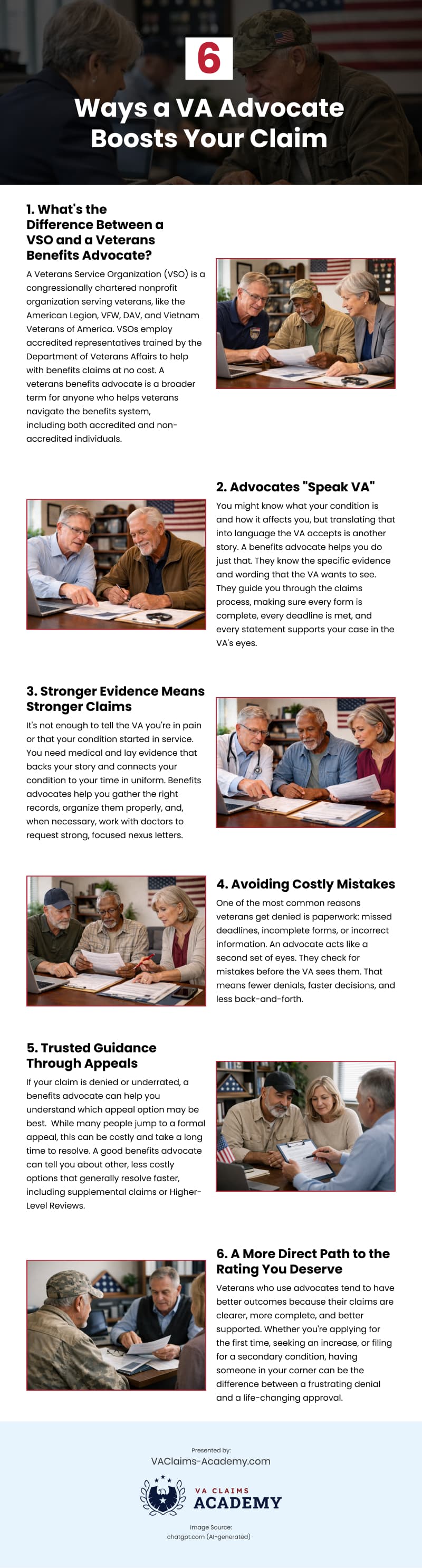
The VA claims process can feel overwhelming, especially for veterans managing the physical and emotional challenges of service‑related conditions. A veteran’s benefits advocate can provide crucial guidance and support. Check out this infographic to learn how a VA advocate can strengthen your claim.