
If you’re dealing with respiratory issues, unusual fatigue, high-blood pressure, unexplained chronic medical symptoms, or cancer-related warning signals, you’ve probably wondered whether toxic exposure could be part of the story.
The PACT Act expands VA health care and benefits for veterans exposed to Agent Orange, jet fuel, asbestos, toxic water, burn pits, and other toxins. Your first step is figuring out whether your service and your health history match the eligibility rules.

(Drazen Zigic/Freepik)
You don’t need to approach this like a legal puzzle. You can get a clear answer about your eligibility for PACT Act compensation by checking two things:
- Where and when you served
- Whether your condition fits what the VA recognizes under PACT-related rules
If you qualify for PACT Act benefits, you will likely find that this is one of the easiest VA claims to win. That’s because you won’t have to provide a “nexus letter” proving that your disability is service-connected. Under the PACT Act, that connection is presumed.
Step 1: Confirm Your Service Location and Time Period
Eligibility starts with location and dates. If your records show service in certain areas during certain time frames, the VA may presume exposure for burn pits or other hazards.
The VA’s public health guidance lists qualifying locations and time periods, including service on or after September 11, 2001, in places such as Afghanistan, Djibouti, Egypt, Jordan, Lebanon, Syria, Uzbekistan, Yemen, and the airspace above them. You can verify your service details using your DD-214, deployment orders, travel vouchers, evaluations, or unit records.
If you served in multiple places, write them down. Then match them against the VA’s location guidance. It’s easier to do this once with focus than to guess while you’re filling out forms.
Step 2: Check Whether Your Condition Fits PACT-Related Presumptives
The PACT Act is known for expanding presumptive conditions. A presumptive condition means the VA recognizes a link to qualifying service without requiring you to prove every detail of exposure. That doesn’t mean your claim approves itself; you still need a current diagnosis and records that show your condition and severity.
For burn pits and other airborne hazards, the VA has identified a set of presumptive conditions tied to qualifying service locations and dates. If you have a diagnosis that appears on the VA’s list, your claim often becomes simpler because the service connection question is less of a fight.
If your condition isn’t on a presumptive list, you can still qualify. Your path usually depends on medical evidence and a well-supported medical opinion (nexus letter) that connects your condition to service.
Step 3: Get Your Toxic Exposure Screening on The Calendar
If you’re enrolled in VA health care, you should be getting a toxic exposure screening every five years. This is a 10 to 15-minute test that can reveal exposure to various environmental hazards. If you have a VA appointment with your primary provider coming up, you can ask for this screening. If not, you can ask to set one up by contacting your local VA office. You can also call 1-800-MyVA411, ext. 8. They may even be able to offer you a virtual screening.
At your screening, be specific about where you served, what hazards you believe you were exposed to, and what symptoms/diagnoses you’re dealing with now. When you share these details with your provider, you’re building a clear record that can support future medical decisions and disability ratings.
Step 4: Decide What You’re Actually Filing For
Many veterans mix up health care eligibility and disability compensation. The PACT Act touches both. It significantly expands your eligibility to enroll directly in VA health care, even if you haven’t applied for disability benefits yet. It can also connect you to screenings and care that can help you qualify for disability benefits.
Before you file, list your symptoms in plain language and match each one to a diagnosis in your medical records. If you have symptoms that don’t match up with a formal diagnosis, see your doctor and get that diagnosis documented. A current diagnosis is crucial for getting a VA disability rating increase.
Step 5: If You Were Denied Before, You May Have A New Opening
A lot of veterans were denied in the past because the VA didn’t recognize certain conditions as presumptive. For example, before the PACT Act, if you developed cancer, such as melanoma, pancreatic cancer, lymphoma, etc., you had to prove that the cancer was caused by your burn pit exposure. But now, the VA considers those cancers “presumptive.” This means that if you can prove that you served in a certain area and time frame linked to burn pit exposure, the VA will assume that your cancer was caused by this exposure and extend disability benefits without your having to prove a “nexus” between your cancer and the toxins.
The PACT Act list is still expanding, so make sure to check VA.gov/PACT frequently. If you have been denied but now see your condition on the presumptive list, you can file a supplemental claim1using VA Form 20-0995.
Before reapplying, make sure to pull your decision letter and look at the reason for your denial. If anything was amiss that is not remedied by PACT Act additions, make sure to fill in those gaps.
With a supplemental claim, you’re not starting from zero. You’re updating the claim using today’s rules and stronger documentation. If your claim is well-developed, you should hear back in just a few months (maybe faster).
Practical Example: Turning “I Was Exposed” Into A Clean Claim
Say you served in a qualifying location after 2001, and you’ve dealt with chronic breathing problems that now have a formal diagnosis. If you file with a clear diagnosis, supporting treatment records, and service evidence that matches the VA’s recognized PACT Act locations and dates, the VA has fewer gaps to question.
If your condition is not presumptive, your goal changes. You focus on building the medical connection through records and a provider’s opinion (nexus letter) that explains why your condition aligns with your service and exposure history. You’re still eligible to pursue the claim. You’re just using a different evidence strategy.
What To Do Next
Start by gathering your service documents and your current diagnoses, then checking your service against VA PACT resources (found at VA.gov/PACT).
Here’s a quick recap of what to do next:Confirm your service locations and dates.
- Schedule your toxic exposure screening if you’re enrolled in VA healthcare.
- Make sure you have a current diagnosis in writing. If not, see your doctor right away and get one.
- Line up your evidence (military service records and healthcare records) and file a new claim or supplemental claim.
Don’t Suffer Without Support If you put yourself in harm’s way through service-related toxic exposure, it’s time to get the help you deserve. And The PACT Act was designed to make things easier on you.
Even if you’ve been denied in the past, the Act may have opened up new opportunities to get VA benefits without a nexus letter. Check out PACT Act resources. And don’t be discouraged if your service or health condition doesn’t qualify. You may still be able to get benefits with a well-supported claim. Contact us for veteran disability claim assistance.
Video

Infographic
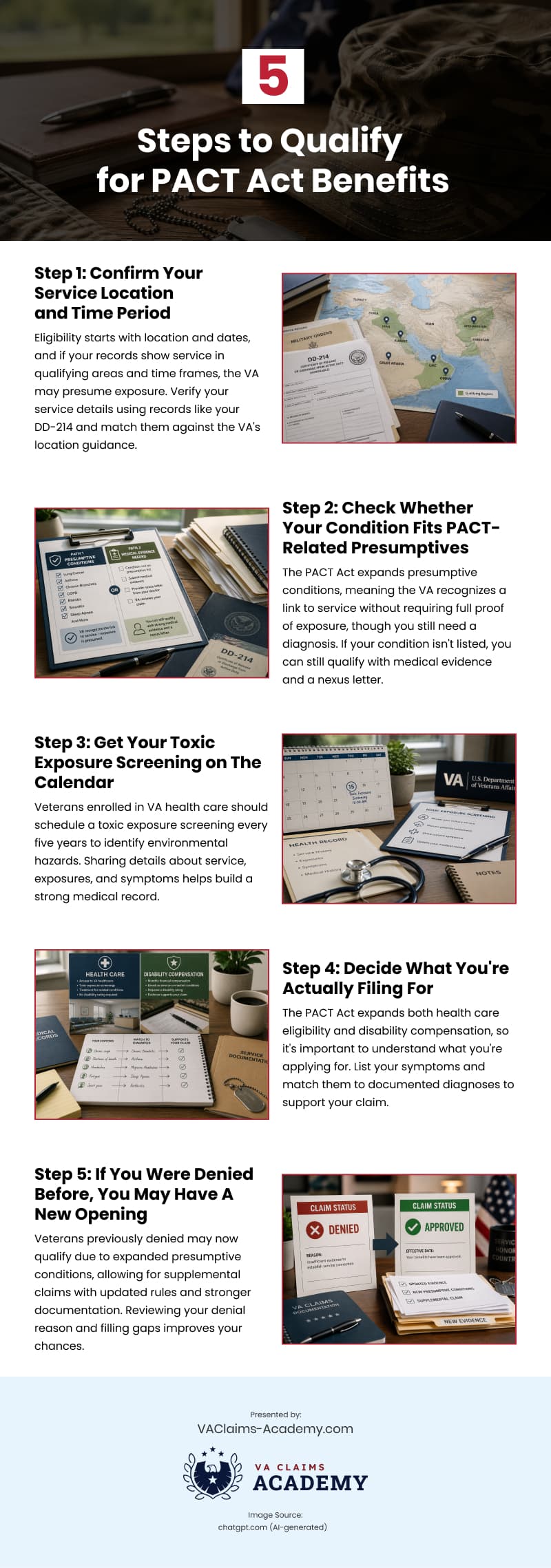
The PACT Act expands healthcare and disability benefits for veterans exposed to toxic substances such as burn pits, Agent Orange, asbestos, jet fuel, and contaminated water. This infographic outlines the key steps veterans must follow to qualify for PACT Act benefits.
1https://www.vba.va.gov/pubs/forms/vba-20-0995-are.pdf