When a VA disability rating decision arrives, the first thing you will most likely look for is the percentage rating you received. After all, this percentage determines what level of benefits you can receive.
If that number feels too low, it can unleash a trove of emotions. You may feel abandoned by the country you helped defend, hopeless about your financial future, or frustrated by a bureaucratic process that can make it very difficult to get an accurate rating.
If your rating seems wrong, it does not automatically mean the VA acted unfairly, but it does mean you should look closely at the file. Rating mistakes happen. The VA can underrate a condition, miss a secondary issue, choose the wrong “effective date,” or rely on an exam that did not capture the intensity of your symptoms.

(freepik/magnific)
Common VA Mistakes and Oversights
The VA is staffed by people. Many are well qualified, but regardless, they’re still people. And people make mistakes. Here are some of the mistakes our VA claim consultants commonly see.
- The VA used incomplete or weak medical evidence.
- The compensation and pension (C&P) exam missed key symptoms or functional limits.
- The VA failed to connect a secondary condition.
- The rating percentage does not match the symptoms in your records.
- The effective date is too late, which reduces your back pay.
A knee claim is a good example. You may have received a rating for limited motion, but the VA may have missed separate nerve symptoms or instability that could support additional compensation.
In a PTSD case, the VA might assign 50% even though your treatment notes support a 70% level based on work problems, isolation, and impaired judgment.
Your Appeal Plan: Start With the Rating Decision Letter Itself
To figure out why the VA may have underrated you, start with the decision letter. This letter tells you more than your percentage. It explains what the VA granted, what it denied, the evidence it reviewed, and why it made those choices. That explanation is where you find the real issue.
You want to look for specific problems. Maybe the VA acknowledged your diagnosis but said the symptoms fit a lower rating level. Maybe the VA discounted evidence that showed greater limitations, or maybe it denied a related condition that should have been considered secondary. Sometimes, the error is simple. Other times, it is buried in the details.
Either way, treat your decision letter like a road map to future claims success. Pay close attention to the section that explains the rating criteria. If your symptoms match a higher level than the VA assigned, that gives you a starting point. If the letter mentions a C&P exam, compare the VA’s explanation to what actually happened at that exam. If you need help understanding the implications of the letter, reach out to a specialist who helps with VA claims.
Compare the Decision to Your Evidence
Once you have read the decision letter carefully, compare it to your records. Read your treatment notes, imaging reports, private medical opinions, personal statement, and buddy letters. See whether the VA left anything out or gave too much weight to one weak piece of evidence.
The answer is usually in the gap between what the VA relied on and what your full record actually shows. For example, if your back condition flares up badly after repeated use but the exam only measured your motion on a relatively good day, the record may understate the real severity. If your migraines cause missed work and your notes show that pattern clearly, but the decision barely mentions it, you may have a basis to challenge the rating.
Decide Which Review Option Fits Your Situation
If you think you have grounds to appeal your rating, you generally have three options. The right one depends on the type of error and whether you have new evidence.
- A Higher-Level Review works best when the VA already had the right evidence and still got the decision wrong. Your reviewer may have confused your effective dates, applied the wrong rating formula, or misinterpreted your medical documentation. With this review, a more senior evaluator will examine your file. You do not need to submit new evidence for a Higher-Level Review.
- A Supplemental Claim may be the best choice if you can add something to your file that could prompt the VA to change its decision. For example, maybe you didn’t have a clear diagnosis. Or perhaps you can present better evidence tying your condition to your military service. Or maybe you can add new medical records that show that your condition is getting worse.
- A Board of Veterans Appeal may be an appropriate path to getting a higher rating for highly complex cases, but it can also be the longest route to an appeal. It is common for BVA reviews to take five years or more. Often, these cases are best handled with the help of a lawyer, but many law firms garnish your back pay, which can end up being very costly.
Let the Evidence Do the Talking
Some veterans jump straight into one of these appeals without checking whether they have a strong case. If you can’t point to a specific review error, you probably shouldn’t proceed with a Higher-Level Review. If you don’t have new evidence to strengthen your file, you probably won’t succeed with a Supplemental Claim.
As a baseline, make sure this evidence is in line before you consider an appeal:
Current diagnosis. Was your original diagnosis clear and current? You need more than a description of your symptoms. You need a named diagnosis and records to show that you are currently under a doctor’s care for that diagnosis.
Nexus letter. If your in-service records don’t show a clear relationship between your disability and your military service, you can strengthen your claim with a nexus letter. These letters can be written by a private physician. They should show that it is “more likely than not” that your condition was caused or worsened by your military service. If you need help getting one of these letters, our VA claims specialists offer templates to present to your private physician. If they haven’t written a nexus letter before (or haven’t written many), this letter can save them a lot of time and ensure they use language that will resonate with the VA.
Personal statement. A personal statement discusses how your disability developed in relation to your military service, how your disability changed or worsened over time, and how it affects you on a daily basis at work and in your interpersonal relationships. This letter can add a lot of “oomph” to your VA claim. It can fill in gaps in your treatment records and give the VA an accurate picture of just how severe and limiting your condition is.
What if Your C&P Exam Went Wrong
Your C&P Exam has a big effect on your VA rating. It tells the VA reviewer whether your condition is linked to your military service and how it aligns with different rating thresholds.
But not all exams go as they should. Maybe the examiner rushed through the appointment. Maybe they ignored flare-ups, downplayed your symptoms, or wrote conclusions that do not match your treatment history.
If that happened, you can file a Supplemental Claim disputing the exam. Do not just say the exam was bad. Point to the exact problem. Show how the report conflicts with your records, leaves out key symptoms, or uses reasoning that does not hold up. Then support your position with better evidence. This could include an independent medical opinion (IMO) from a physician or copies of past healthcare records that contradict the C&P examiner’s assessments.
Watch the Deadline
You generally have one year from the date listed on your VA decision letter to appeal, whether through a Higher-Level Review, Supplemental Claim, or Board appeal. Missing the review window can hurt more than momentum. It can cost you back pay based on the original claim’s effective date.
Act with purpose, even if you are still deciding which lane to use. Review the decision, organize your records, gather the evidence, and choose the response that best addresses the problem.
Focus on the Priorities
If you think the VA got it wrong, you may want to argue everything at once. We get it. We’ve been there. A denied or underrated claim can be maddening. But don’t let your frustration jeopardize your case. Trying to cover too much in your appeal can weaken your case. Focus on the most important point the VA got wrong and build around it.
If the problem is your migraine frequency, prove the frequency clearly. If the problem is your PTSD rating level, show the work and social impairment that fits the higher criteria. If the problem is a secondary condition the VA missed, document the connection carefully.
A focused case is easier for the reviewer to follow and harder to dismiss.
Video
Infographic
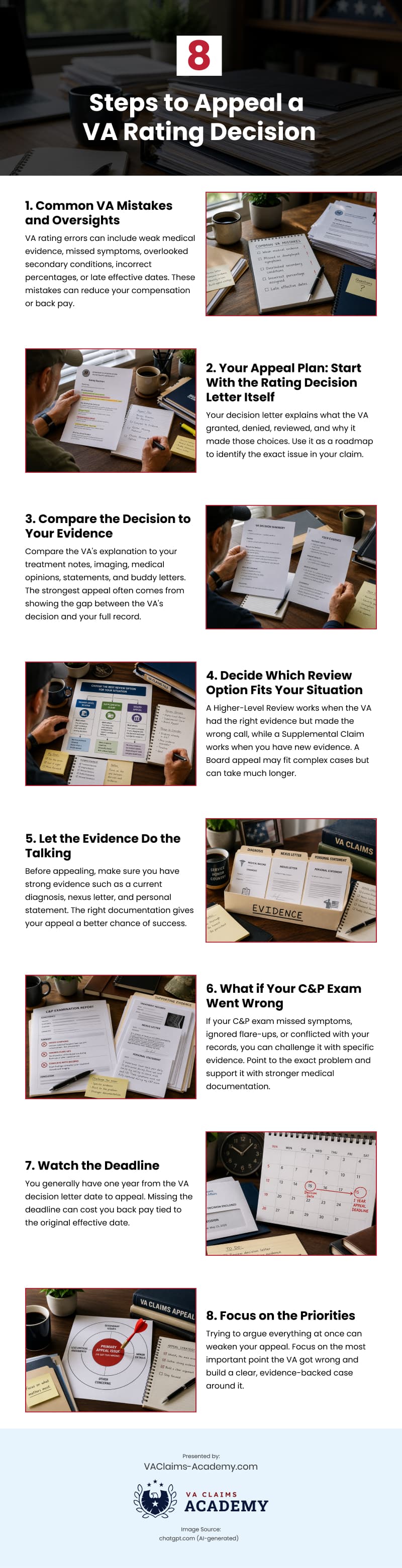
A VA rating that feels too low can leave you frustrated, confused, and unsure what to do next. Read on to see how the infographic below walks you through eight steps to appeal a VA rating decision with confidence.