38 CFR § 4.130, Insomnia (rated as a mental health condition)
- Typical Rating Range: 0%,10%, 30%, 50%, 70%, 100%
Are you a veteran dealing with ringing, buzzing, hissing, or clicking in your ears? If so, you’re not alone. Tinnitus is one of the most commonly reported service-connected disabilities among veterans. But what happens when that ringing doesn’t just bother you during the day but keeps you up at night, too? Many veterans suffer from insomnia secondary to tinnitus, and the good news is that the VA recognizes this connection.
Our VA claims experts help veterans maximize VA disability through a number of methods, including secondary service connections. They have put together this guide to walk you through the process for filing for insomnia as a secondary service condition. Read on to learn more about what constitutes a secondary condition, how insomnia ratings work, and how to prepare a winning claim.

image
The Link Between Tinnitus and Insomnia
Tinnitus involves the perception of noise in the ears without any external sound. This means you can hear the noise, but the people around you can’t. And while tinnitus might seem like a small annoyance to those who don’t have it, the reality is that chronic tinnitus can cut deep into your quality of life.
One of the most devastating effects of tinnitus is the way it disrupts your sleep. Your nights might replay like a bad dream. You toss and turn and can’t fall asleep. When you finally do drift off, the noise in your ears wakes you up. This can happen over and over again throughout the night. You may wake up feeling like you didn’t sleep at all and have trouble staying awake and alert during the day.
If you have a VA rating for tinnitus, and your tinnitus is causing these kinds of sleep disruptions, it may be time for you to look into insomnia as a secondary condition.
How a Secondary Service Connection Works
To win a VA claim for insomnia as a secondary condition, you must show that your sleep disorder didn’t arise independently but as a result of your already approved tinnitus.
A secondary service connection allows you to receive additional compensation for a new condition that results from an existing service-connected disability.
In your case, the primary condition is tinnitus. The secondary condition is insomnia.
Getting the VA to Approve Insomnia as a Secondary Condition
To receive benefits for insomnia as a secondary condition, you need to demonstrate that your sleep problems are more than just occasional restlessness. They must be chronic, medically documented, and directly linked to your tinnitus.
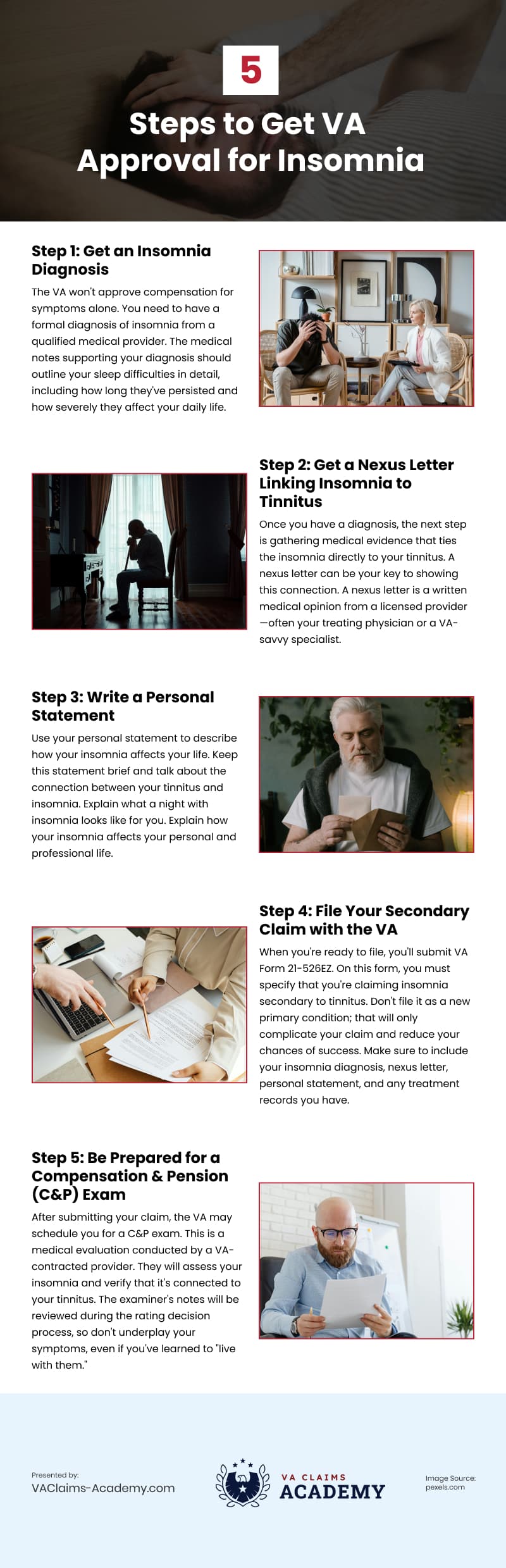
Step 1: Get an Insomnia Diagnosis
The VA won’t approve compensation for symptoms alone. You need to have a formal diagnosis of insomnia from a qualified medical provider. The medical notes supporting your diagnosis should outline your sleep difficulties in detail, including how long they’ve persisted and how severely they affect your daily life.
If you’ve never spoken with a provider about your sleep problems, your first step is to schedule an appointment. Be honest and specific about how tinnitus is affecting your sleep. If you’re waking up due to the noise in your ears, lying awake for hours, or experiencing daytime fatigue, those are all important details to share. The goal is to build a clear and consistent medical record.
If you have a diagnosis for insomnia but haven’t been seen for it recently, schedule a visit with your provider. This shows that your insomnia diagnosis is current.
Step 2: Get a Nexus Letter Linking Insomnia to Tinnitus
Once you have a diagnosis, the next step is gathering medical evidence that ties the insomnia directly to your tinnitus. A nexus letter can be your key to showing this connection. A nexus letter is a written medical opinion from a licensed provider—often your treating physician or a VA-savvy specialist. It should state that your insomnia is “at least as likely as not” caused or aggravated by tinnitus.
The language “at least as likely as not” is critical. It’s the legal standard the VA uses to approve service connection claims. A well-written nexus letter will explain how your tinnitus disrupts your sleep, cite relevant medical studies or observations, and clearly outline the cause-and-effect relationship between the two conditions.
Without a nexus, your claim is much more likely to be denied, even if your insomnia is well-documented.
Step 3: Write a Personal Statement
Use your personal statement to describe how your insomnia affects your life. Keep this statement brief and talk about the connection between your tinnitus and insomnia. Explain what a night with insomnia looks like for you. Explain how your insomnia affects your personal and professional life. Are you irritable with your spouse and kids? Do you fall asleep during work meetings? Or make careless mistakes on the job because you can’t focus? Put these details in the letter.
A personal statement provides a way to communicate directly to the VA reviewer.
Step 4: File Your Secondary Claim with the VA
When you’re ready to file, you’ll submit VA Form 21-526EZ.1 On this form, you must specify that you’re claiming insomnia secondary to tinnitus. Don’t file it as a new primary condition; that will only complicate your claim and reduce your chances of success.
Make sure to include your insomnia diagnosis, nexus letter, personal statement, and any treatment records you have. If you’ve received therapy, taken sleep aids, or discussed your symptoms with VA doctors, those notes can further support your claim.
You can file the claim online through VA.gov, by mail, or with the help of a Veterans Service Officer (VSO).
Step 5: Be Prepared for a Compensation & Pension (C&P) Exam
After submitting your claim, the VA may schedule you for a C&P exam. This is a medical evaluation conducted by a VA-contracted provider. They will assess your insomnia and verify that it’s connected to your tinnitus.
During the exam, be open and honest about how your sleep is affected. Describe the specific symptoms you experience (such as difficulty falling asleep or waking up due to ear noise) and how fatigue impacts your ability to function at home and on the job. The examiner’s notes will be reviewed during the rating decision process, so don’t underplay your symptoms, even if you’ve learned to “live with them.”
Understand How the VA Rates Insomnia
Tinnitus is typically capped at a 10% rating. But insomnia falls under the General Rating Formula for Mental Disorders and may be rated at 0%, 10%, 30%, 50%, 70%, or even 100%, depending on how it affects your occupational and social function.
0%: Insomnia is diagnosed but not bad enough to interfere with occupational and social function or to need continuous medication.
10%: Mild insomnia symptoms cause some occupational and social impairment. You may be less efficient at work or have difficulty performing some tasks on occasion OR need continuous medications to control your symptoms.
30%: Occupational and social impairment with occasional periods when you cannot perform certain occupational tasks.
50%: Occupational and social impairment plus consistently decreased reliability and productivity.
70%: Occupational and social impairment with deficiencies in most areas of life (work, school, family, judgment, critical thinking, mood, etc.)
100%: Total occupational and social impairment (including impaired thought processes and communication patterns).
Keep in mind that if you already have other mental health conditions rated by the VA, insomnia might be factored into those existing conditions rather than rated separately. In such cases, insomnia could still raise your total combined rating, even if it doesn’t get its own standalone percentage.
Many veterans assume that they don’t qualify for higher-level insomnia ratings based on the descriptions above. However, they may be overlooking certain symptoms or simply need help putting their symptoms into the right words on their VA claim. A VA claims consultant can help you use “VA speak” to get the full rating that you are entitled to.
Get the Benefits You Deserve
Claiming insomnia secondary to tinnitus may seem like a complex process, but it’s one that many veterans have navigated with success. If tinnitus is keeping you up at night, that’s not something you just have to accept. It’s a real, documented issue, and the VA recognizes its impact.
With an evidence-backed claim and the right supporting documents, you can significantly increase your chances of receiving the benefits you’re entitled to. You served your country, and that entitles you to the full range of benefits for your tinnitus and the insomnia it causes.
1https://www.vba.va.gov/pubs/forms/vba-21-526ez-are.pdf
Video
Infographic
Veterans with tinnitus often experience insomnia as a secondary condition, and the VA acknowledges this link when evaluating disability claims. This infographic outlines steps to obtain VA approval for insomnia.