
Do you have a near-constant ringing in your ears? Maybe it is a buzzing noise or even a hissing sound?
You aren’t alone. Tinnitus is the most common disability among veterans, with over 2.5 million 1 veterans receiving disability benefits because of tinnitus.
For some, tinnitus might be a nuisance, but it is a life-altering condition for others. It can lead to other health issues, including mental health problems like depression and anxiety.
If you suffer from tinnitus, we can teach you strategies for submitting a robust claim that demands VA approval.
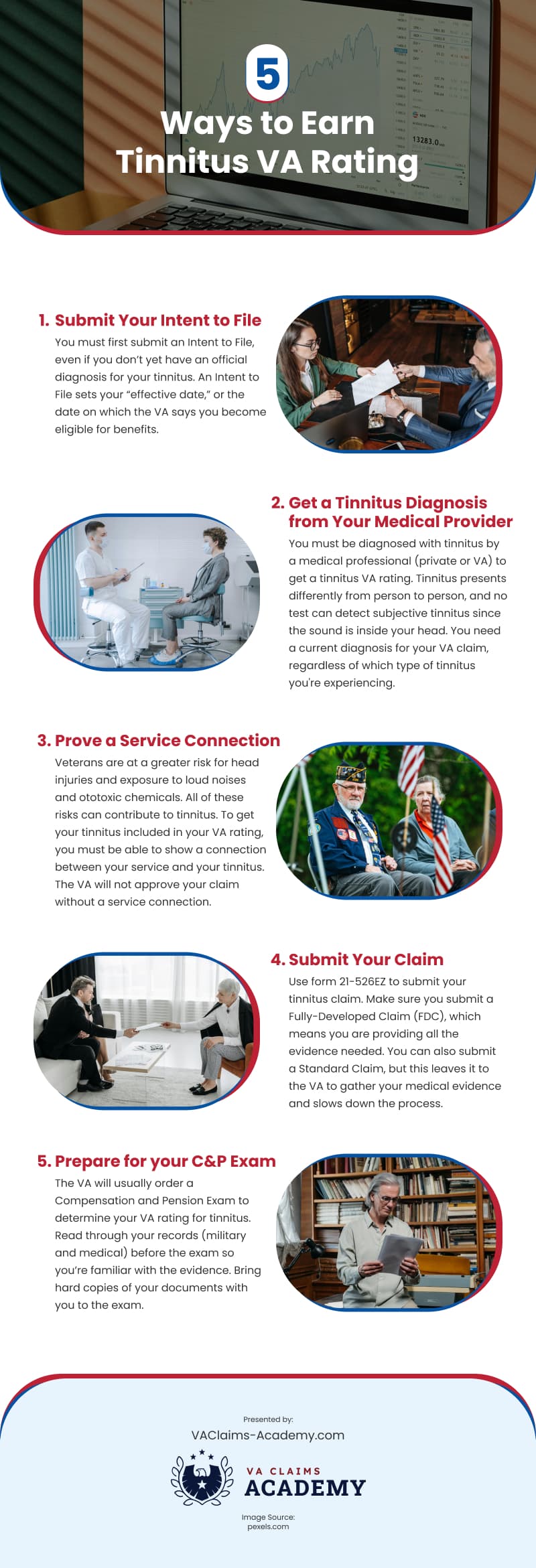
Here are five steps for successfully getting your tinnitus VA rating.

image
1. Submit Your Intent to File
You must first submit an Intent to File, even if you don’t yet have an official diagnosis for your tinnitus. An Intent to File sets your “effective date,” or the date on which the VA says you become eligible for benefits.
Once you have submitted your Intent to File, you have one year to complete the claim.
2. Get a Tinnitus Diagnosis from Your Medical Provider
You must be diagnosed with tinnitus by a medical professional (private or VA) to get a tinnitus VA rating.
Tinnitus presents differently from person to person, and no test can detect subjective tinnitus since the sound is inside your head.
If you are suffering from objective tinnitus, your doctor may be able to hear clicking or crackling in your middle ear.
You need a current diagnosis for your VA claim, regardless of which type of tinnitus you’re experiencing.
3. Prove a Service Connection
Veterans are at a greater risk for head injuries and exposure to loud noises and ototoxic chemicals. All of these risks can contribute to tinnitus. In fact, veterans are twice as susceptible to tinnitus as non-veterans, according to the National Institutes of Health.2
To get your tinnitus included in your VA rating, you must be able to show a connection between your service and your tinnitus. The VA will not approve your claim without a service connection.
But how can you do that? There are a couple of ways to connect your service to your condition.
Write a Statement in Support of Claim
One of the ways to show a service connection is through a Statement in Support of Claim, a short statement that you complete, in your own words, on VA Form 21-4138. This statement provides details about the in-service event, injury, or illness that contributed to your tinnitus.
Your Statement in Support of Claim should include the following:
- When the event happened (be as specific as possible on the dates)
- Where it happened
- What you were doing when it happened
You can also have someone submit a Statement in Support of Claim on your behalf, detailing the in-service trigger that led to your tinnitus. When someone does this on your behalf, it is called a buddy letter.
A buddy letter could be written by the person you were standing next to on the flight line who also developed tinnitus or the people who worked with you on the same noisy machines.
Nexus Letter
Another way to establish a service connection is through a nexus letter. The VA doesn’t technically need a nexus letter to assess your claim, but it is one of the most impactful tools for establishing a service connection.
In a nexus letter, your provider will vouch for the link between your tinnitus and the in-service event, injury, or disease that caused it. They might use wording like “it is as least as likely as not” that your tinnitus was caused by military service.
Generally, any doctor licensed to practice medicine in the US should be able to write you a nexus letter. However, it is worth asking if your doctor provides this service, as not all do. You can make your provider’s job easier by providing them with a plug-and-play nexus letter from VA Claims Academy.
4. Submit Your Claim
Use form 21-526EZ to submit your tinnitus claim. Make sure you submit a Fully-Developed Claim (FDC), which means you are providing all the evidence needed. You can also submit a Standard Claim, but this leaves it to the VA to gather your medical evidence and slows down the process.
5. Prepare for your C&P Exam
The VA will usually order a Compensation and Pension Exam to determine your VA rating for tinnitus.
- Read through your records (military and medical) before the exam so you’re familiar with the evidence.
- Bring hard copies of your documents with you to the exam.
- Don’t be a tough guy/gal. This is the time to be brutally honest about your symptoms and the way they hurt your quality of life.
If You are Unsuccessful
If your initial tinnitus claim is unsuccessful, don’t be discouraged. The VA can deny claims for many reasons that might not have anything to do with your condition. It might be a missed deadline, a filling error (like using the wrong form), or even missing a date or a signature.
If your claim for tinnitus is unsuccessful, you can:
● Ask for a Higher Level Review.
An advanced-level VA adjudicator will re-assess your claim to see if mistakes were made in the previous review.
● Submit a Supplemental Claim
A supplemental claim provides further supporting evidence of your condition. This process means you aren’t starting over from scratch but adding more to what you have already sent in.
● Begin an Appeal
Starting an appeal to the Board of Veterans is your last resort for an unsuccessful claim. An appeal is a lengthy legal process that takes many years to resolve. You should exhaust all other options before involving lawyers and going this route. Lawyers have little incentive to accelerate your claim because they usually work for contingency fees. This means they keep a portion of your retroactive disability pay. The longer your case drags on, the more money attorneys stand to make.
We Can Support You Through This
Many veterans don’t file for a tinnitus VA rating because the process seems so overwhelming. However, there are ways to crack the VA code and get the rating you deserve, and it’s not as difficult as you might think. VA Claims Academy shows you a clear path to a VA rating for tinnitus.
Infographic
For some, tinnitus is just a nuisance, but for others, it can significantly impact their lives, leading to challenges like depression and anxiety. If you have tinnitus, explore this infographic for five steps to successfully obtain your tinnitus VA rating.
1https://www.military.com/benefits/veterans-health-care/tinnitus-is-number-one-disability-for-veterans.html
2https://pmc.ncbi.nlm.nih.gov/articles/PMC6263445/