If you’re applying for a VA disability increase, you’ll likely get called in for a C&P exam. If the exam goes poorly, you could receive an unfavorable VA medical opinion. This usually means that the VA considers it “less likely than not” that your health condition is connected to your military service.
Let’s say you are trying to get a VA rating for back pain. The VA examiner will look for evidence in your military medical and service records about an injury or event(s) that contributed to your pain. If they don’t find it, they may try to say that your back pain was caused before entering the military or after you got out. Without a connection or “nexus” between your back pain and your military service, you will not be eligible for benefits.
An unfavorable VA medical opinion can feel like a gut punch, especially when it comes after you’ve waited months for a decision. You might have expected a strong case outcome, only to receive a denial or a low disability rating because a VA medical provider didn’t see things your way.

(Drazen Zigic/Freepik)
You Can Fight Back
VA claims are driven by medical evidence. When you file for disability benefits, the VA looks closely at what doctors say about your condition—especially during a C&P exam. If the examiner states that your condition isn’t service-connected or doesn’t meet the rating criteria, it can become the primary reason for a denial.
Unfortunately, these opinions aren’t always accurate. You may have seen private doctors for years and documented symptoms supporting your VA claim. But if the VA examiner spends five minutes with you and claims your symptoms are “mild” or unrelated to service, that single opinion can derail everything.
The good news is that this is not the end of the road. This article is designed to give you help with VA claims that enables you to fight back.
Step 1: Read the Rationale Carefully
Start by reviewing the actual language used in the VA medical opinion. Look at the reasons the examiner provides for their conclusions. Do they mention that you didn’t show significant symptoms during the exam? Do they dismiss your diagnosis because it wasn’t made in-service? Do they ignore key facts in your service records?
Most unfavorable opinions can be challenged if you can show that they are based on incorrect information, overlook key medical history, or lack supporting evidence. The VA is required to provide a well-reasoned explanation for denying service connection or assigning a lower rating. If the opinion lacks depth or skips over major parts of your case, you have grounds to fight back.
Step 2: Request Another C&P Exam
A C&P exam must be thorough and accurate. If you don’t believe yours was, you can request another one. Just make sure you act quickly so you can get the exam lined up before the VA officially denies your claim.
Start by calling the VA hotline to report the issue: 1-800-827-1000. Explain the problems with your C&P exam and request another one.
Then, write a Memorandum for Record (MFR) documenting your experience at the exam. Include:
- The examiner’s name
- What the examiner said
- Why you feel the exam was not as thorough or accurate as it needed to be, e.g., “My examiner only spent a few minutes with me,” or “My examiner never asked about the in-service events that caused my condition.”
Go to your VA.gov account and find the claim in question. Then, upload the MFR to that file.
Step 3: Get a Nexus Letter
If it was an unfavorable medical opinion that sabotaged your case, fight back by getting your own private independent medical opinion (IMO), also known as a nexus letter. This letter, written by a medical provider, shows the “nexus” between your condition and your military service.
Your private doctor can review your full medical and service history and write a detailed explanation about why they think your condition is connected to your military service. They do not have to state this with 100% certainty. Rather, they can claim that it is “at least as likely as not” or “more likely than not” that your condition is service-connected. That language is often enough to move the needle.
Unlike C&P examiners, these private providers work for you. That means they can take more time with your case and provide a thorough analysis. You’ll want to choose a provider with relevant experience. Ideally, you should choose a medical provider who is familiar with VA claim requirements and who specializes in the field of medicine relevant to your injury. For example, if you are claiming knee pain, you could request an IMO from an orthopedic surgeon. If you are claiming depression or anxiety, you could request an IMO from a psychiatrist.
While private opinions aren’t automatically given more weight than VA opinions, a well-reasoned and fully supported private opinion can carry significant influence. Contact VA Claims Academy to find nexus letter doctors who can advocate for you with a well-written independent medical opinion.
What If Your Claim Has Already Been Denied?
There are a couple of ways to proceed after a denial. One option is to request a Higher-Level Review, where a more experienced VA reviewer examines your case to ensure it was handled correctly.
A second option, if you have more evidence to add to your claim, is to submit a supplemental claim. Additional evidence could include service records, medical records, a personal statement, buddy letters, or a nexus letter.
What if the VA Disputes Your Nexus Letter?
The VA is used to getting nexus letters, and sometimes they come from large organizations that produce dozens of these letters each day. If the VA thinks your letter came from one of these nexus letter “mills,” they may push back. But you can push back, too, explaining that your doctor actually examined you in-person and provided facts and medical results to back up their opinon.
If the VA argues that you paid your doctor to write the letter, you can point out that VA doctors are also paid. There is no restriction against paying a provider to write a nexus letter. However, the VA probably won’t like it if the doctor who wrote the letter is in another state and didn’t ever get the chance to examine you in-person.
If the VA rejects your nexus letter, you can go back to the doctor who wrote the letter and ask them to write a rebuttal letter. In this letter, your private doctor should explain why their first nexus letter is still valid and provide any additional rationale or clarification to support the connection between your military service and your connection.
What Makes a Medical Opinion Strong or Weak?
Understanding the quality of the opinion is just as important as the conclusion itself. A weak medical opinion is usually short, vague, or based solely on limited interaction. If the examiner doesn’t address your full medical history or fails to explain how they reached their conclusion, the opinion holds less weight.
On the other hand, a strong opinion—whether from the VA or a private provider—will:
- Cite specific medical records and timelines
- Provide a clear nexus between service and diagnosis
- Reference accepted medical literature or diagnostic criteria
- Explain how symptoms meet the VA’s rating standards
If the VA’s opinion lacks these elements but your private opinion includes them, you have a real chance of turning your claim around on appeal.
Stay Persistent and Proactive
Getting an unfavorable VA medical opinion can be frustrating, but it’s not a final sentence. The VA system allows for multiple levels of appeal, and many veterans ultimately win their claims by providing better evidence and sticking with the process.
Make it a habit to maintain organized records. Keep notes from medical visits, personal statements about how your condition affects daily life, and any letters from employers, family, or friends who’ve seen your symptoms firsthand. This kind of lay evidence can support your case, especially when paired with a strong medical opinion.
Don’t let one examiner’s limited view define your entire case. By pushing back strategically, you can regain control of your VA disability journey and secure the rating and recognition you’ve earned.
Video
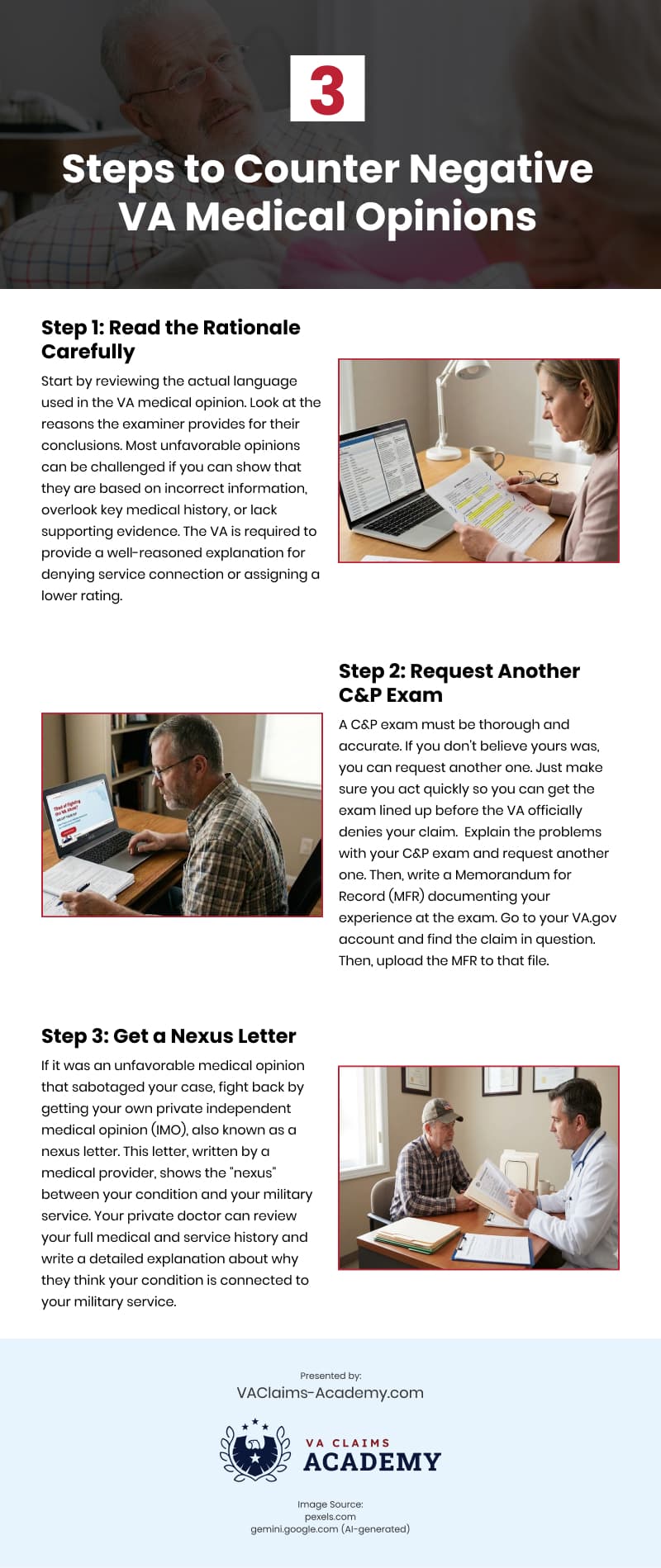
Infographic
An unfavorable VA medical opinion can be discouraging, especially after months of preparation and confidence in your claim. But it doesn’t mean your case is over. Explore this infographic to learn the key steps for addressing negative VA medical opinions.