
The VA can feel like a monstrous, mysterious machine. All you know is that you served your country, you got hurt in the process, you were promised certain things, and now the VA is denying you.
You know you are entitled to more compensation, but you don’t know how to convince the VA—nor do you have the time or patience to figure it out. And besides, from what you’ve heard, the VA appeals system is completely backed up. Who has years to wait only to potentially get denied again?
We’re here to tell you that the reason most veterans get denied is not that they don’t deserve a higher VA rating. (The vast majority of veterans are underrated.) It’s that they don’t take three key steps to strengthen their claim—even though these three steps are relatively simple.
In this article, we’ll teach you about these all-important steps and put you on a path to get a VA rating increase.

image
A Hack: Filing a Supplemental Claim
Whether you’re trying to increase your VA disability rating for the first time, or trying again after your claim for an increase has been denied, your best option may be to file a supplemental claim.1
A lot of people try for an appeal, but that’s like starting from the beginning. You’ll go to the bottom of the pile and have to wait a long time (potentially several years) for a review.
The supplemental claim, on the other hand, allows you to submit new and relevant evidence to increase your VA rating without having to completely start over with your claim.
3 Key Steps
We have seen hundreds of veterans—even those who have been out of the military for 30 to 40 years—get the 100% VA disability benefits rating that they are entitled to with these steps.
1. Get a Diagnosis
In order to get a rating increase, you want to think like a VA adjudicator. The first thing they will want to know is that your illness or injury is legitimate. To prove this, you need a diagnosis. If it’s evident in your service treatment records from your active enlistment, great. Or maybe it’s in your VA records from after you got out of the military. It could also be in your private medical records from a civilian provider.
Beyond just having a diagnosis on paper, your records need to be current. They should show that you have recently received treatment for your diagnosis—ideally within the last few months.
2. Prove a Service Connection
A lack of a service connection is at the root of most denied claims. Put yourself back in the shoes of the VA reviewer. They don’t want to give you a VA rating for a health problem that is unrelated to your military service, so they are looking for evidence that your disability has a direct connection to your service.
The challenge is that plenty of veterans don’t get treated for their service-connected injuries while in the service. They’re told to “suck it up” instead of going to the doctor. As a result, there’s no record of a health challenge developing in connection with a specific military event.
Nexus Letter
If your military records don’t show a clear service connection for your injuries or illness, a nexus letter will be your friend. A nexus letter is one of the most powerful tools in your VA disability arsenal.
A nexus letter should be written by a doctor with language like “it is at least as likely as not” that your disability was caused by your military service. The “at least as likely as not” verbiage is a pretty low bar—especially when you consider that the reward could be a tax-free pension for life.
There are firms that specialize in writing nexus letters for you, but avoid going to a “nexus letter mill” where they churn out hundreds of these letters. The VA is onto these companies and will consider their letters with a grain of salt.
Another idea is to go to your own physician with a template for a nexus letter. This makes it very easy for them to create a letter that speaks to what the VA needs to hear. VA Claims Academy can provide you with one of these plug-and-play nexus letters to present to your doctor.
Personal Statement
Another way to prove a service connection is through a personal statement. A lot of veterans overlook the magic of personal statements, thinking they won’t hold much weight because they’re not written by an authority. But you are an authority on your own life and military service. Your statement can provide important details about when your injury or illness developed, what triggered it, and how it has affected your daily life over the years.
For example, maybe you have back pain, but the VA doesn’t see an obvious service connection because you were a computer programmer. You, however, know that the office setup you worked in was not ergonomically designed. You also know that you were subjected to physical trainings with a lot of jumps and running that wreaked havoc on your back. Your personal statement can fill in the gaps between your diagnosis, your military service, and your current condition.
Make sure to write your personal statement in layman’s terms (no fancy jargon needed). Worry less about making your statement long and more about making it relevant. A 15-page letter with dozens of impertinent details will be less compelling than a one-page letter that shares the specific details the VA needs for the rating process.
To stay on track, ask about our VA Claims Academy personal letter template that will help you stay laser-focused on what the VA wants to know.
3. Convey How Severe Your Condition Is
A useful analogy is that the military is the rental car driver, and you’re the rental car owner. They take your car out for a spin and return it with dents and dings representing the physical damages you suffered in the military.
If you want full payment, you need to walk the rental car driver through all of the damages they caused and ask for compensation. The same with the VA.
You can use your personal statement to convey how your disability affects your life. How bad is your pain? How often does it affect you, and how intense is it? Does it keep you from walking? Standing? Playing with your kids? Sleeping? Are you in so much pain that it’s difficult to hold down a regular job?
Another way to show how severe your condition is is with your DBQ (disability benefits questionnaire) to be completed in your C&P exam at the VA clinic or hospital. You can also get a DBQ from your private doctor. Your doctor can use language such as “John’s back pain is severe enough to correspond with a 70% VA rating.” A DBQ from your doctor can be a powerful tool to help you increase your VA rating.
Where to Start
If you’ve been denied for a higher rating, take a look at your decision letter. It will likely contain hints about which of the above three areas were weak with your previous claim. Once you’ve identified weaknesses, you can follow our guidance above to submit a stronger claim.
The process of submitting a VA claim doesn’t have to be hard; it just has to be done right. VA Claims Academy provides education, resources, and templates that make it easier to get a VA disability increase. We can help close gaps in your claim and take the pain out of navigating VA processes.
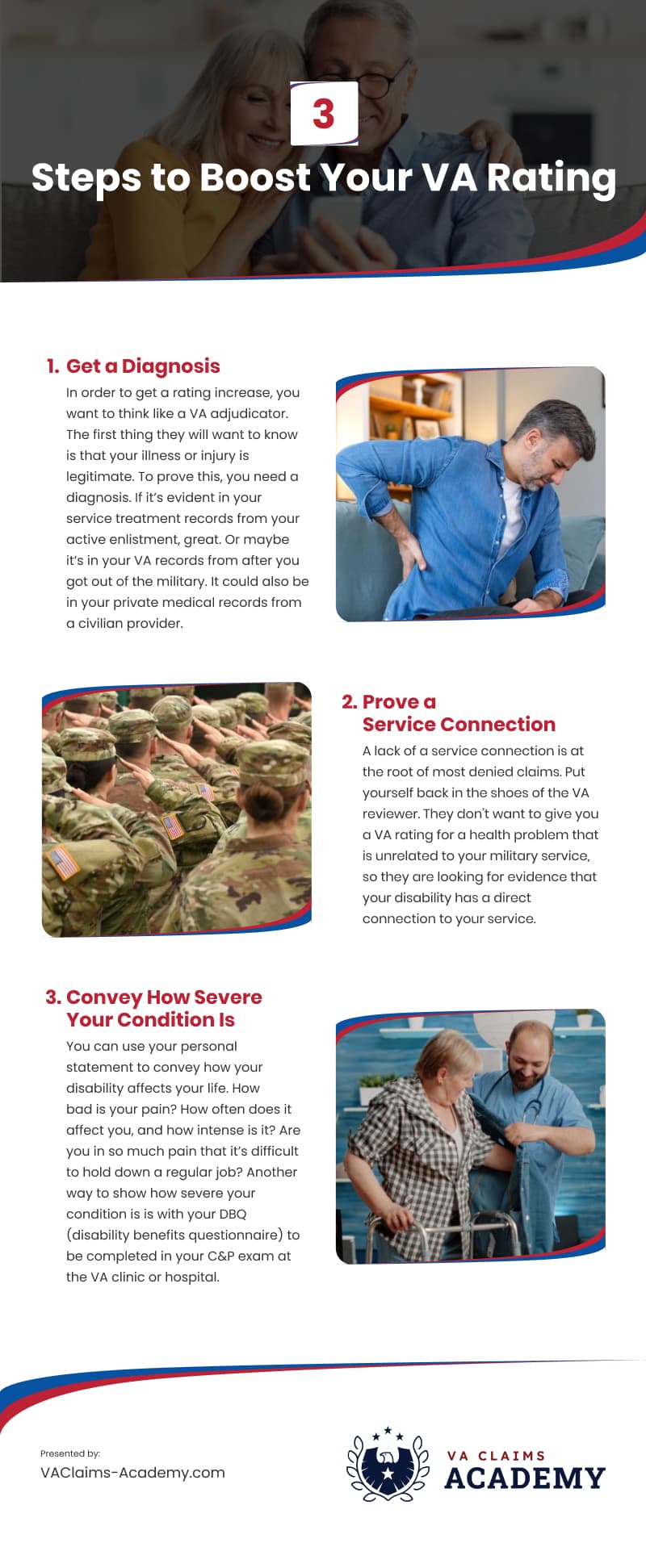
Infographic
Navigating the VA can feel overwhelming. After serving your country and facing injuries, you know you deserve compensation. If you’re unsure how to approach the VA and don’t have the time or patience to navigate the process, this infographic outlines essential steps to help you pursue a VA rating increase.
1https://www.va.gov/decision-reviews/supplemental-claim/