
38 CFR § 4.130
Diagnostic Codes:
- 9400 (Generalized Anxiety Disorder)
- 9403 (phobias)
- 9410 (other specified anxiety disorders)
- 9412 (panic disorder and/or agoraphobia)
- 9413 (unspecified anxiety disorder)

(Andrea Piacquadio/pexels)
If you’re struggling with service-connected anxiety, you know the impact goes far beyond nerves or occasional stress. This isn’t just about feeling uneasy—it’s about how your anxiety disrupts your daily functioning, relationships, and ability to work. Yet despite how severe your symptoms may be, the VA might have rated your condition too low.
Too many veterans are underrated for anxiety. In fact, our experience has shown us that most veterans with service-connected anxiety are underrated. But the good news is that you can take strategic steps to increase your VA anxiety rating. The majority of veterans we work with are able to get their anxiety rating up to 70% or higher.
In this guide, you’ll learn what the VA looks for in anxiety claims, how ratings are determined, and what you can do to strengthen your case and get the compensation you deserve.
How the VA Rates Anxiety Disorders
First, it’s important to understand how the VA assigns ratings for mental health conditions like Generalized Anxiety Disorder (GAD), Panic Disorder, or Anxiety Secondary to PTSD. The VA uses the General Rating Formula for Mental Disorders, which includes ratings at 0%, 10%, 30%, 50%, 70%, and 100%.
Your rating is based on how much your anxiety interferes with your social and occupational functioning, not just whether you’ve been diagnosed or are receiving treatment.
Here’s a breakdown of how your symptoms might line up with common rating levels:
- 0% rating: You have an anxiety diagnosis, but your symptoms aren’t bad enough for ongoing medication, and they don’t interfere significantly with your professional or social life.
- 10% rating: You have mild or intermittent symptoms that affect your social and professional function, but only when you are under significant stress, OR your symptoms are controlled by ongoing medication.
- 30% Rating: You have occasional periods of being unable to perform in your social or work life due to anxiety, panic attacks, etc.
- 50% Rating: You have decreased reliability and productivity due to your anxiety symptoms, such as suffering from panic attacks more than once per week. You may forget to complete tasks, have impaired judgement, and struggle to gather motivation and regulate your mood.
- 70% Rating: You are impaired in your ability to function at work and school and in family relationships. You also have deficiencies in your general thinking processes, judgment, and mood regulation. You may struggle with suicidal thoughts, near-continuous panic, impaired impulse control, spatial disorientation, and self-care.
- 100% Rating: To earn a 100% disabled veteran benefits rating for anxiety, you will need to show total occupational and social impairment due to symptoms like grossly impaired thought processes or communication abilities, ongoing delusions or hallucinations, inappropriate behavior, persistent risk of harming yourself or others, difficulty orienting to the present place or moment, inability to remember even familiar things, and inability to carry out daily routines (such as self-care).
Signs You May Be Eligible for a Higher Anxiety Rating
A lot of people see the rigid breakdowns above and assume they don’t qualify for a higher rating. But there are different ways to interpret the ratings and show how your symptoms fit into this framework.
You might be able to boost your VA anxiety rating if you’re experiencing:
- Frequent panic attacks, severe sleep disturbances, or constant anxiety that limits your ability to function
- Social withdrawal or inability to maintain close relationships
- Difficulty keeping a job or functioning in a structured work environment
- Regular suicidal ideation or overwhelming feelings of hopelessness
- Need for frequent psychiatric hospitalization or crisis intervention
- Frequent “zoning” out (this could fall into the spatial or time disorientation described in the rating schedule)
- Difficulty with self-care (meaning you are not maintaining things like hygiene, sleep consistency, or fitness like you used to)
These symptoms suggest that your condition could meet the threshold for a 70% or even 100% rating.
Key Evidence for Your VA Anxiety Rating Increase
The VA won’t automatically increase your rating just because your symptoms have worsened. You need to build a case that clearly demonstrates the impact of your anxiety on your professional and social life. Here’s how:
1. Get a Current Diagnosis
Chances are, you didn’t complain about your anxiety when you were in the service. The priority was on being tough so you could support your fellow soldiers and the country, so maybe you hid or downplayed your symptoms. But this doesn’t mean you can’t get rated now, and the first step is to get a current diagnosis. So if you don’t have a formal diagnosis, see your provider right away. An official diagnosis shows the VA that the condition exists and is significant enough that you are currently being treated for it.
2. Gather Medical Evidence
Request updated records from your psychiatrist, therapist, or primary care doctor related to your anxiety. Make sure your symptoms are documented consistently, and that your providers note how your anxiety affects your ability to work, interact with others, and perform daily activities.
3. Write a Personal Statement
If you have received free help from a Veterans Service Officer (VSO), they may not have told you about the importance of writing a personal statement. This is an often-overlooked piece of evidence that can work wonders for your VA claim. Since anxiety can’t be seen by something like an X-ray or scope, this personal statement serves as a closer look at exactly how your anxiety affects your daily life.
Did your anxiety cause you to get fired from your last job? Did it lead to your divorce? Does it keep you from going out with friends like you used to? Include specific details like these in your letter.
Do not talk about other things in your life that contributed to your anxiety—that will not help your case. Rather, focus exclusively on in-service experiences, environments, or events that may have contributed to your anxiety and describe how your anxiety affects your life on a daily basis.
4. Solicit Buddy Letters
Ask family members, friends, coworkers, or people you served with in the military to write about what they’ve witnessed with your anxiety. They could record how your anxiety affects your mood, behavior, reliability, and relationships. These personal insights fill in even more gaps that medical records often miss.
5. Prepare Thoroughly for Your C&P Exam
You will likely be called in for a Compensation & Pension (C&P) exam. This will be conducted by a VA physician or a contracted provider. They are not trying to treat you at this exam. Rather, they are assessing your service connection (the link between your anxiety and your military service) and the severity of your symptoms and providing data points for your VA examiner.
Bring your medical records and your personal statement to your appointment. In fact, you can ensure that you share the most pertinent details by reading your statement to your doctor.
Be very honest in your exam. Don’t sugarcoat your symptoms. Your doctor needs to hear about your worst moments and see you as you really are—not with your game face on.
6. Get a Nexus Letter
A lot of veterans think they don’t have a shot at a rating increase if they weren’t diagnosed with anxiety while serving in the military. But the truth is, most soldiers who have service-connected anxiety were not diagnosed or treated while serving.
The good news is that it’s not too late. You can still strengthen your claim with the help of a nexus letter. A nexus letter is a letter from your current doctor saying that “it is at least as likely as not” that your current condition was caused by your time in service.
Try to get this letter from a board-certified mental health provider. They may not know how to write a nexus letter, but a VA claim consultant can help you provide them with a template to make their job easier and ensure they are covering all the information the VA wants to see.
How Do I File for a VA Rating Increase for Anxiety?
If your anxiety has worsened or your current rating doesn’t reflect your reality, you can file a claim for an increase. You can use the VA’s online portal or mail in VA Form 21-526EZ.1 Include all your updated evidence and be specific in describing your symptoms.
Consider a Secondary Claim
Let’s say that you developed hearing loss due to your time in service, and your hearing loss contributed to your anxiety. You now have the potential for a secondary claim. Secondary claims allow you to file for an increase based on a new health condition that developed because of a primary service-connected condition. So in this case, you would be filing for anxiety secondary to hearing loss.
You can file for this increase even if you have a 0% rating for your hearing loss. The bottom line is that if your service-connected condition has led to another condition, you have the right to file for a rating increase. You can use VA Form 21-526EZ to file your secondary claim.
Don’t Settle for a Lowball Anxiety Rating
If your current VA rating doesn’t reflect the full extent of your anxiety struggle, it’s time to take action. Raising your VA rating isn’t just about compensation—it’s about acknowledgment. It’s about having your mental health taken seriously and getting access to resources that help you function, heal, and live with dignity.
You’ve already served. You shouldn’t have to fight another uphill battle alone. With the right strategy, documentation, and support, you can get closer to the 100% rating you’ve earned.
Video
Infographic
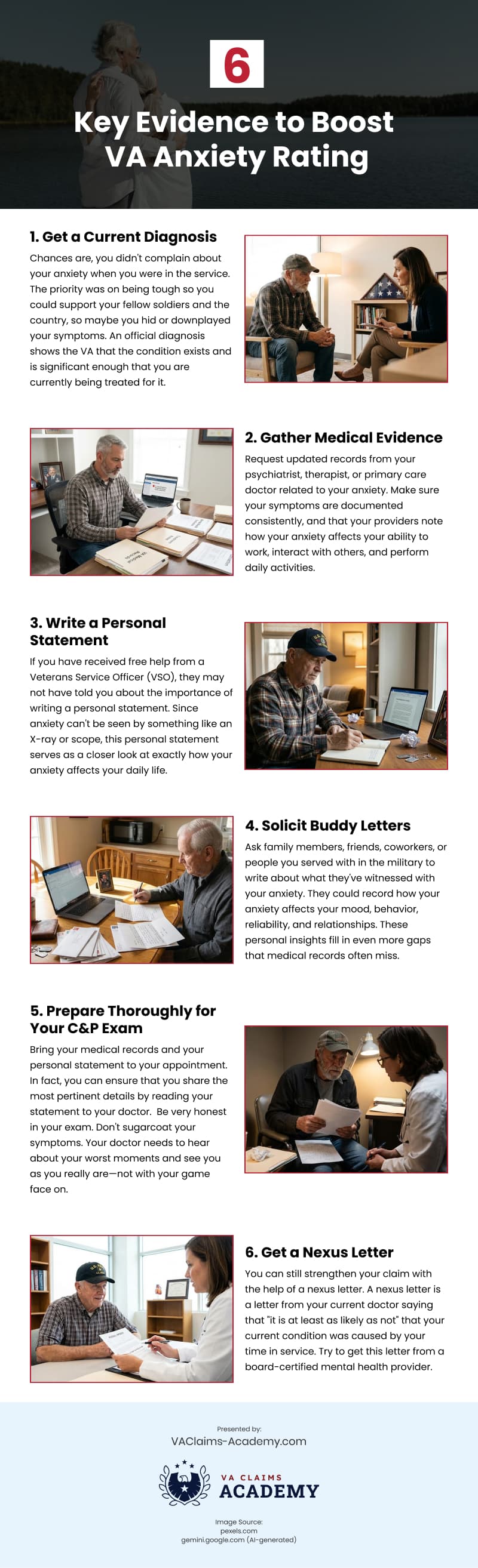
Many veterans are underrated for service-connected anxiety. To improve your VA rating, it’s essential to present a clear, evidence-based case that demonstrates how anxiety impacts your work, relationships, and daily life. This infographic highlights key evidence to help boost your VA anxiety rating.
1https://www.vba.va.gov/pubs/forms/vba-21-526ez-are.pdf