The VA claims process can feel impossible…especially if you’ve been denied in the past. How do you break through the mass of bureaucracy and finally get the rating you are entitled to?
The good news is, there are ways to crack the code. With the right strategy and the right evidence, you have a strong chance of increasing your VA rating in a reasonable amount of time. And one of the most important tools for getting that increase is a nexus letter.

image
What Is a Nexus Letter?
A nexus letter is a statement from a medical professional that directly links a veteran’s disability to their military service. The VA requires evidence to establish a service connection, and in cases where the link is not obvious, a nexus letter provides the professional medical opinion needed to strengthen a claim.
Unlike standard medical records that only document a veteran’s health history, a nexus letter explicitly explains how a veteran’s condition is “at least as likely as not” caused or aggravated by their service.
The letter typically includes a medical rationale, often referencing the veteran’s service treatment records, medical research, or clinical expertise to support the claim.
When Is a Nexus Letter Necessary?
Not every VA disability claim requires a nexus letter. However, a nexus letter is particularly important in cases where the service connection is not automatically presumed. Here are some scenarios where a nexus letter becomes essential:
● Lack of Clear Service Records
If you do not have clear, documented medical records from your time in service, it will be challenging to prove that your condition is service-related. A nexus letter from a doctor who has reviewed your case can provide the necessary medical validation.
● Secondary Conditions
Some disabilities arise due to a primary service-connected condition. For example, a veteran with a service-connected knee injury may later develop chronic back pain due to altered posture and movement patterns. A nexus letter can establish this secondary service connection.
● Supplemental Claims and Appeals
If your VA claim has been denied, you can submit a supplemental claim, which adds new evidence to your claim for the VA to review. You can also appeal your denial, but be warned that the appeals process can take quite a bit longer than filing a supplemental claim—years in some cases.
Regardless of the route you choose for submitting your claim for further review, a well-written nexus letter can address gaps in the case and provide additional justification for a rating increase.
● Post-Service Diagnosis
Some medical conditions, such as PTSD or Agent Orange-related illnesses, can develop years after military service. A nexus letter helps demonstrate that the condition likely originated from the veteran’s time in service, even if symptoms were not immediately apparent.
Key Components of a Strong Nexus Letter
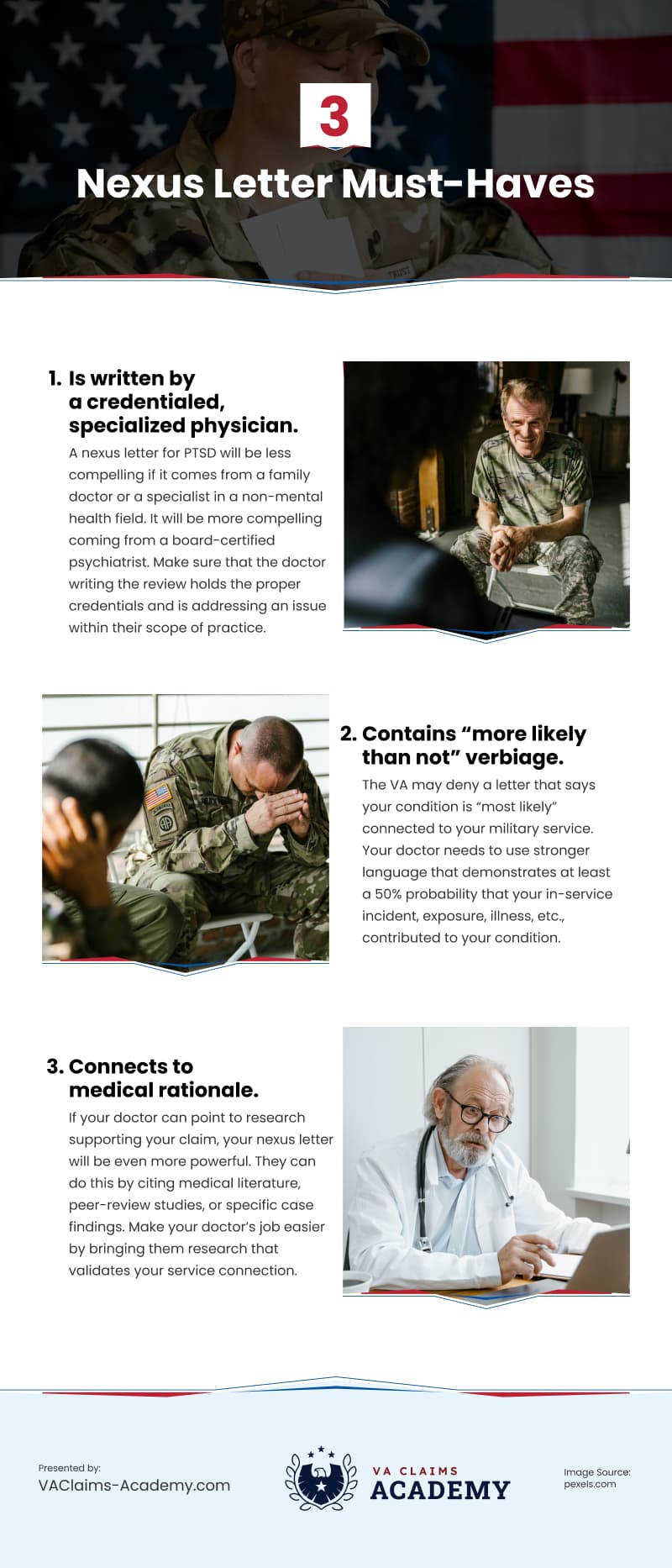
Just having a nexus letter alone won’t ensure a winning path for your claim. Make sure your nexus letter:
1. Is written by a credentialed, specialized physician.
A nexus letter for PTSD will be less compelling if it comes from a family doctor or a specialist in a non-mental health field. It will be more compelling coming from a board-certified psychiatrist. Make sure that the doctor writing the review holds the proper credentials and is addressing an issue within their scope of practice.
2. Contains “more likely than not” verbiage.
The VA may deny a letter that says your condition is “most likely” connected to your military service. Your doctor needs to use stronger language that demonstrates at least a 50% probability that your in-service incident, exposure, illness, etc., contributed to your condition.
Examples:
It is at least as likely as not that [the patient’s] tinnitus is connected to their work on the flight line.
It is more likely than not that [the patient’s] knee arthritis is due to their service as a paratrooper.
3. Connects to medical rationale.
If your doctor can point to research supporting your claim, your nexus letter will be even more powerful. They can do this by citing medical literature, peer-review studies, or specific case findings.
Make your doctor’s job easier by bringing them research that validates your service connection. For example, if you developed high blood pressure after serving near burn pits in Iraq, come to your appointment with copies of peer-reviewed studies showing the link between burn pit exposure and hypertension.
How to Get a Doctor to Write a Nexus Letter
● Private Medical Providers
If you regularly see a private doctor, you can ask them if they will write a nexus letter for you. If they have not had much experience writing these letters, you can provide resources to simplify the process and make sure they are including details the VA wants to see. It’s a good idea to bring your doctor a “plug-and-play” nexus letter so that they will have a template to guide them.
● VA Doctors
You can request that a VA doctor writes your nexus letter. They may have more experience writing nexus letters than private providers, but they may still need some guidance in the form of a template and/or links to medical studies that prove the correlation between your condition and an inservice event.
In addition, you can point them to VHA Directive 1134(2).1This document directs VA healthcare providers to assist veterans by filling out medical forms and providing medical statements, including nexus letters, which verify a link between a veteran’s health condition and their military service.
What to Avoid When Seeking a Nexus Letter
Some organizations specialize in providing nexus letters for a price, but in recent years, the VA has caught on to these “nexus letter mills.” The VA may deny claims if they notice that the doctor who wrote your nexus letter has written hundreds or thousands of these letters for others. They want sincere, personalized letters, not mass-produced ones.
The VA may raise eyebrows if your letter is written by an out-of-state doctor, because it cues the VA that you may have never set foot in this doctor’s office. If you do decide to use a pay-per-letter service, make sure that it is located in your home state.
Conclusion
A well-drafted nexus letter can make the difference between an approved claim and a denied one. And since not all letters are created equal, maximize your chances of getting a winning letter and 100 percent disabled veteran benefits rating with the help of VA Claims Academy.
We have templates that can help doctors establish a service-connection to various health conditions. We can also help doctors tie in relevant, peer-reviewed studies to help them write a rock-solid, evidence-based letter that paves the way to a higher VA disability rating.
1https://www.va.gov/vhapublications/ViewPublication.asp?pub_ID=4300
FAQs
1. What is the purpose of a nexus letter in a VA disability claim?
A nexus letter provides a medical opinion linking a veteran’s disability to their military service. When the nexus letter makes a clear connection between the veteran’s health condition and their military service, it can strengthen a veteran’s claim and help them increase their VA disability rating.
2. Who can write a nexus letter for VA disability?
Licensed medical professionals such as doctors, nurse practitioners, and specialists can write nexus letters, provided they have expertise in the condition being addressed. These professionals may be private doctors or VA doctors. Their letter will be more compelling if they are writing about a condition that falls within their scope of practice. (Ex: A letter from a board-certified psychiatrist about a veteran’s PTSD may be more compelling than a letter from a family practice physician.)
3. How much does a nexus letter cost?
Costs vary, but private providers and specialized services may charge between $150 to $1,500, depending on the complexity of the claim. Be wary of paying an organization that charges top dollar and churns out thousands of these letters. The VA may recognize these “nexus letter factories” and discredit the letters they write.
4. Do I need a nexus letter for every VA disability claim?
Not always. The VA considers some conditions to be presumptive, meaning they automatically presume that they are linked to military service. For example, certain kinds of cancer are “presumptive” for veterans who were exposed to burn pits.
If your service is not presumptive, you may need a nexus letter. This is especially true when you don’t have clear medical records documenting your condition, when your condition didn’t manifest until after you left the service, or when you have developed a condition secondary to your primary service-connected condition (such as when your original diagnosis of knee arthritis has led to ankle problems over time).
5. Can a bad nexus letter hurt my VA claim?
Yes. A poorly written nexus letter without proper medical reasoning may weaken a claim. It’s essential to get a detailed, well-supported letter from a qualified medical professional stating that it is “more likely than not” that your health condition is service-related.
Video
Infographic
The VA claims process can feel overwhelming—especially after a denial—but a well-crafted nexus letter can be a powerful tool to strengthen your case. Discover in this infographic the key elements of an effective nexus letter to help turn your situation around.